385 / 405 nm
Supports monochrome LCD and DLP systems when matched to the manufacturer's profile.
 THE FAST 3D PRINTGet a quotation →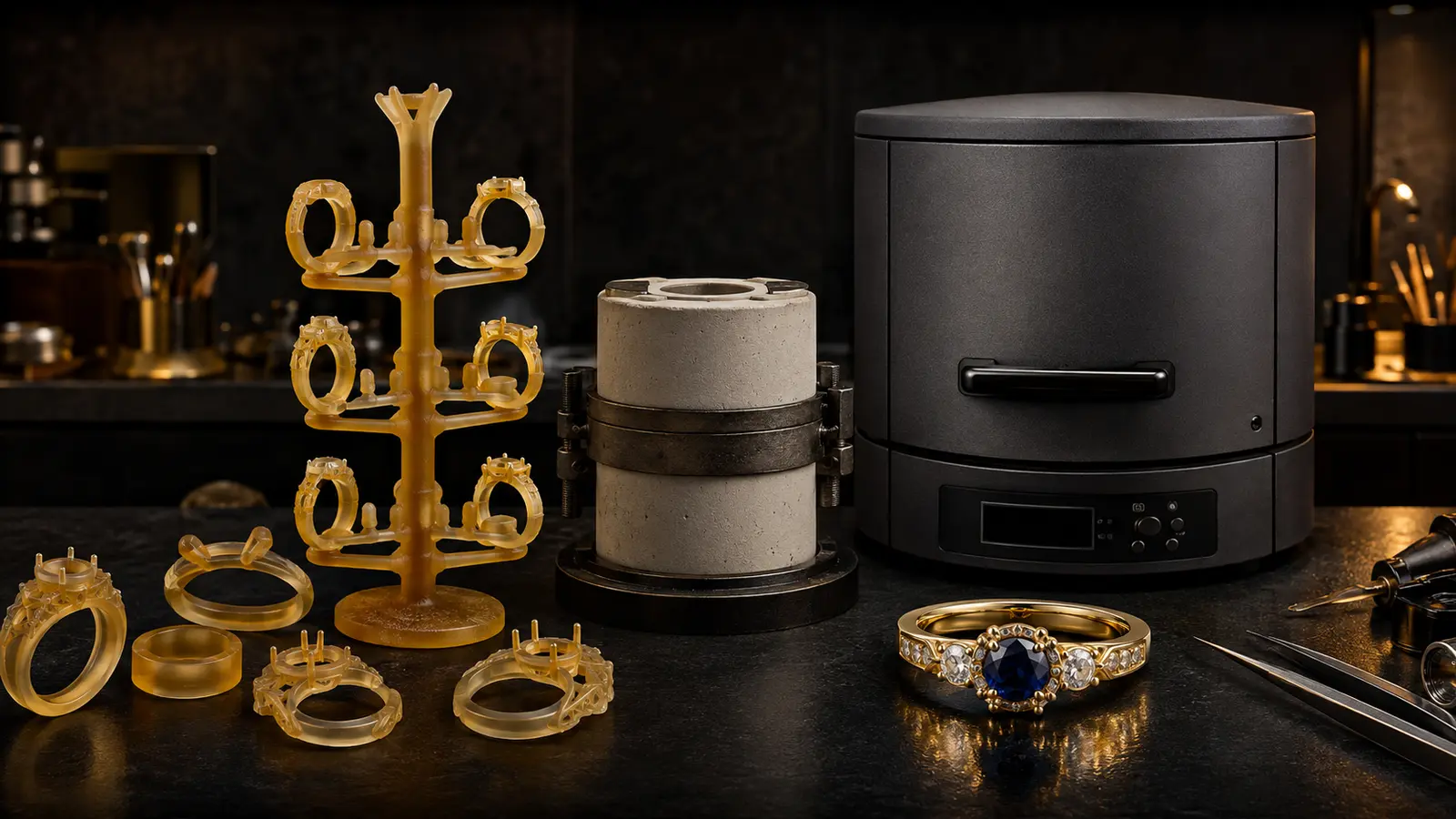
From resin preparation and printing to cleaning, spruing, investment and burnout.
REAL-WAX CASTABLE RESIN
X-Wax is a high real-wax-content jewellery resin for LCD and DLP printers. It behaves more like casting wax during melting and spruing, but needs careful temperature and material preparation.
Supports monochrome LCD and DLP systems when matched to the manufacturer's profile.
Recommended print range; keep the resin temperature stable.
Referenced minimum layer height; thin broad surfaces require additional evaluation.
Reported TGA residue from the product data.
PRE-PRINT
Use a manufacturer-approved temperature-controlled warmer. Avoid food appliances and poorly ventilated areas.
Mix thoroughly for about one minute, then rest briefly to reduce bubbles before filling the vat.
Use suitable PFA/FEP film. Excessively thick or worn film can impair peeling and layer adhesion.
Check the build plate, Z axis and platform rotation; use rounded support contacts to reduce surface marks.
Resin, solvents and burnout require PPE, ventilation and strict compliance with the manufacturer's SDS and instructions.
WASHING & DRYING
INVESTMENT & BURNOUT
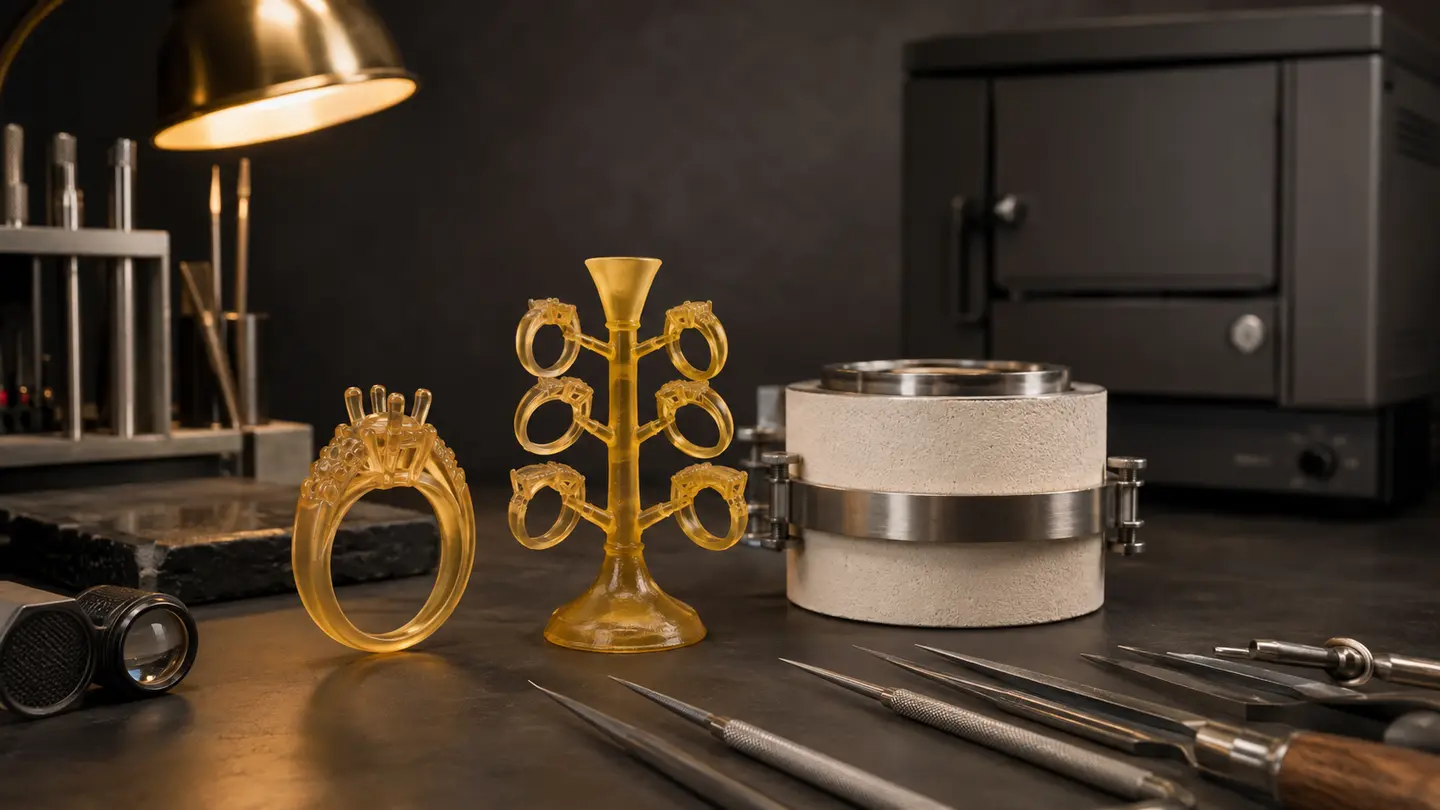
X-Wax patterns can be joined to wax sprues and used in mixed trees. Joints must be secure, smooth and free from crevices that trap investment.
Water-to-powder ratio and burnout cycle must match the investment, flask, alloy and kiln. The source provides long, standard and fast cycles peaking around 700–720°C; these are not universal recipes.
Weigh water and powder, use distilled water and control its temperature.
Break up lumps, then vacuum for the specified time to reduce air and improve homogeneity.
Allow the investment to set for the required time before burnout.
Verify kiln temperature with a probe and manage ventilation as instructed.
DIMENSIONAL ACCURACY
WAX-RICH RESIN CONTROL
High-wax resin can thicken or partially solidify at low temperature. Bringing it into its operating range and mixing it uniformly before filling the vat is important for particle distribution, resin flow and consistent layers.
Use manufacturer-approved, temperature-controlled warming equipment that is never used for food. Avoid uncontrolled heat, which can introduce bubbles or change material behaviour.
The referenced operating range; heated systems are commonly set near 30°C.
Match the print profile to the actual light source and printer.
A suitable, healthy film supports consistent peeling.
Homogenise the material, then allow bubbles to settle before printing.
CASTING TREE
Feed heavier sections and create a continuous filling path.
Abrade the joint area and add wax for a smooth fillet without sharp edges or gaps.
Loose joints and crevices can trap investment and create inclusions after casting.
Maintain enough clearance from walls and between parts for investment strength.
INVESTMENT & BURNOUT CONTROL
No single burnout programme suits every job. Flask size, pattern load, ventilation, kiln accuracy and investment type all affect heat penetration and carbon removal.
Weigh water and powder, use distilled water, control its temperature, mix and vacuum within the working time, then allow the flask to set fully. Shortened rest time or aggressive heating can increase moisture, cracking and surface defects.
Temperatures and times are contextual information. Always prioritise the instructions for the actual resin, investment, kiln and alloy.
SERVICE BUYER GUIDE
Customers seeking castable-resin, jewellery wax printing or complete jewellery casting should distinguish pattern-only work from an end-to-end casting service. Dimensional compensation, sprue, investment, burnout, alloy and finishing all affect the final piece.
Send a file or image with your brief so Fast 3D Print can assess process, material, lead time and price before production.
Send us your file, dimensions, quantity and intended use. Our team can compare process, material, finishing and production risk before work begins.
Discuss your project →