File and size
Send STEP/STL with units, overall size and revision.
 THE FAST 3D PRINTGet a quotation →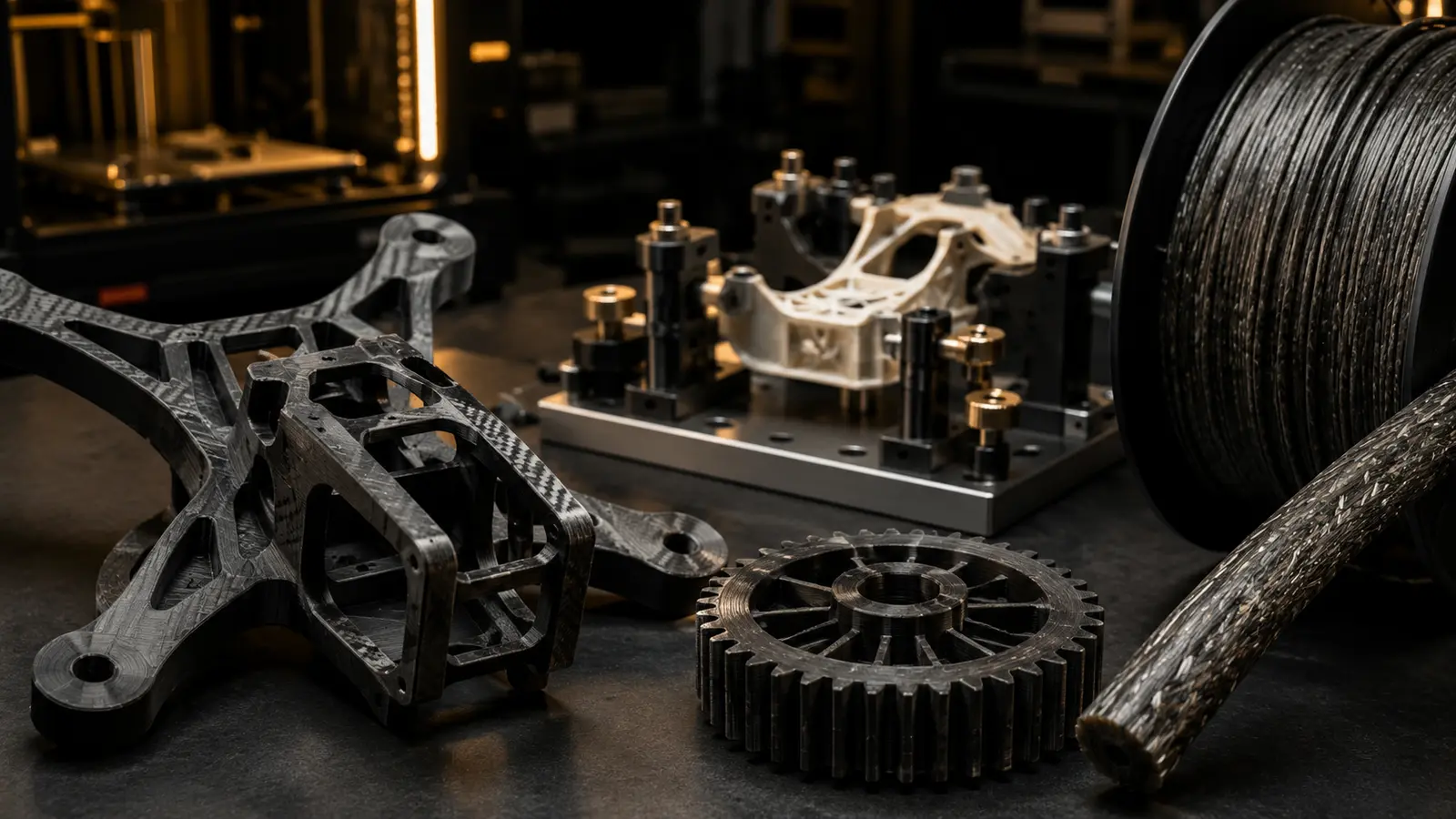
A sourcing guide covering fibre types, properties, load direction, design and the information needed for a quotation.
COMPOSITE MATERIALS
Composite 3D printing uses a polymer matrix reinforced with carbon or glass fibre to increase stiffness, reduce deflection or improve dimensional stability. Typical applications include jigs, fixtures, housings, robotic parts, drone components and low-volume spares.
Most carbon-fibre filament contains chopped fibre dispersed in a polymer; it is not equivalent to laminated sheet or continuous-fibre reinforcement. Performance and cost differ significantly, so a quotation should identify chopped versus continuous fibre and the base polymer.
CHOPPED · CONTINUOUS · MATRIX
| System | Description | Advantage | Suitable use |
|---|---|---|---|
| PA-CF / PETG-CF | Chopped carbon fibre in polymer | Stiff, stable, matte | Housings, drones, robots |
| PA-GF / PP-GF | Chopped glass fibre in polymer | Good compression and heat performance | Jig · Fixture · Tooling |
| Continuous fibre | Fibre paths placed within a polymer matrix | Strong directional reinforcement | Brackets and targeted structures |
| Pellet composite | Pellet extrusion for large parts | High throughput and lower material cost per kg | Patterns and large-format parts |
DESIGN FOR LOAD
FDM parts are anisotropic. Loads that peel layers apart are often critical, so the design brief should define load cases, fasteners, impact, temperature and service life before orientation, perimeters, infill and wall thickness are selected.
Fibre-filled materials are abrasive and can affect holes and fits. Engineering parts may need drilling, machining, inserts or post-print inspection rather than assuming every feature is assembly-ready.
REQUEST A QUOTATION
Send STEP/STL with units, overall size and revision.
State whether the part is a bracket, jig, housing or moving component.
Specify loads, temperature, UV, chemicals, moisture and outdoor exposure.
State quantity, deadline, critical dimensions, fit test and finish.
A competent supplier should identify the matrix, fibre type, build orientation and acceptance method.
Send us your file, dimensions, quantity and intended use. Our team can compare process, material, finishing and production risk before work begins.
Discuss your project →