Moisture
Nylon readily absorbs moisture. Store it sealed with desiccant and dry it according to the manufacturer's data.
 THE FAST 3D PRINTGet a quotation →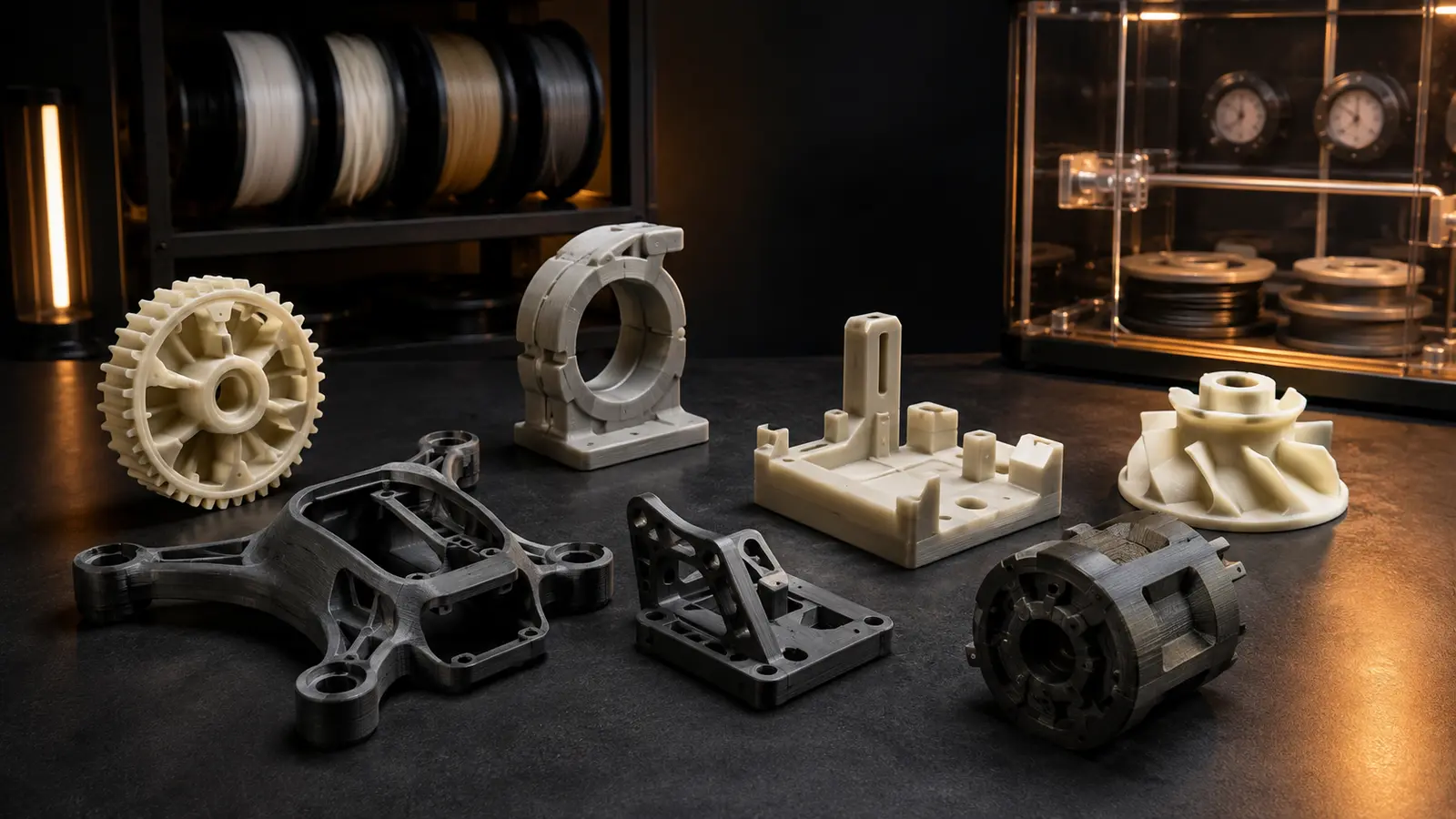
Compare PA6, PA11, PA12 and fibre-reinforced grades for strength, toughness, dimensional stability and heat resistance.
ENGINEERING POLYAMIDE
Nylon or polyamide is valued for strength, toughness, impact and wear resistance, making it suitable for gears, housings, jigs, fixtures, drones, robotics and machinery.
Nylon is a family rather than one material. Moisture uptake, stiffness, flexibility and dimensional stability vary widely, so selection must start from the application.
SEVEN COMMON GRADES
| Grade | Strength | Watch for | Best suited to |
|---|---|---|---|
| PA6 / PA66 | Strong, tough and wear resistant | High moisture uptake and warping | Gears and loaded parts |
| PA6-CF | Stiff, light and stable | More brittle; abrasive | Drones, robotics, structures |
| PA6-GF | High compression and thermal stability | Rougher surface; thin parts may be brittle | Jig & Fixture |
| PA11 | Tough, flexible and impact resistant | Less stiff than CF grades | Snap-fits and protective parts |
| PA12 | Stable, printable and accurate | Less strong than PA6 | Housings and accurate parts |
| PA12-CF | Very stable, low moisture, fine finish | Higher cost; abrasive | Drones, aerospace, precision parts |
| PAHT-CF | High heat and creep resistance | Needs high-temperature equipment | Automotive and demanding industry |
PRINTING CONTROL
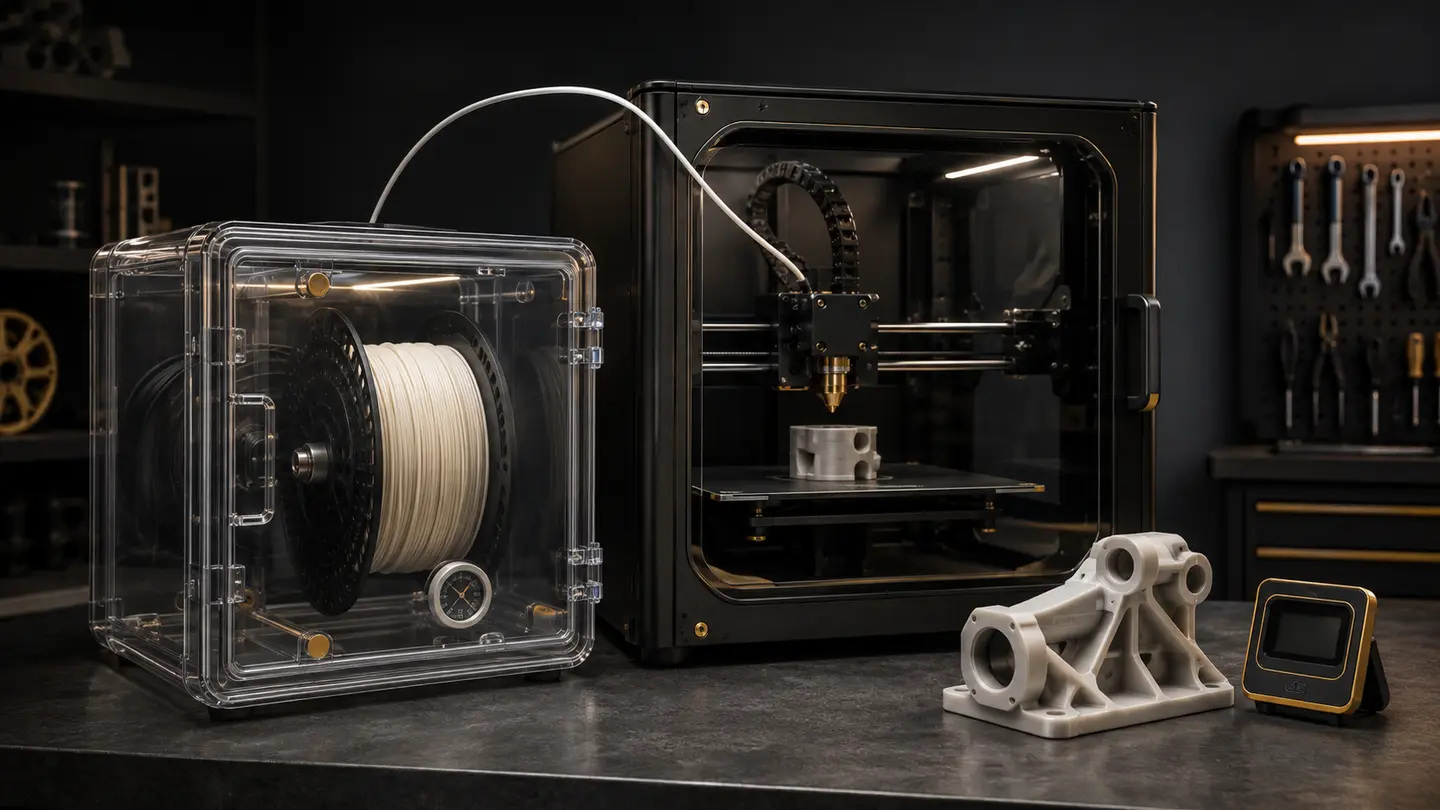
Nylon readily absorbs moisture. Store it sealed with desiccant and dry it according to the manufacturer's data.
High-shrink grades need appropriate bed adhesion and a temperature-controlled chamber.
CF and GF grades are abrasive and require a hardened or similarly wear-resistant nozzle.
Layer-direction strength is anisotropic, so orient the part around its principal loads.
Drying and print settings vary by brand and grade. Always follow the material's technical data sheet.
QUICK SELECTION
PROPERTY MAP
Each nylon family responds differently to load and environment. Tensile strength describes resistance to pulling, modulus indicates stiffness, while elongation and impact strength help describe toughness. Selecting from one number alone can therefore be misleading.
Carbon fibre raises stiffness and dimensional stability but usually reduces elongation. Glass fibre performs well in compression and heat, yet its surface and failure behaviour differ from unfilled nylon. Load direction, wall geometry, fastening points and service life must be considered together.
Important for housings, jigs and parts that must hold position under load.
Important for snap-fits, guards and parts exposed to occasional impact.
Consider moisture uptake, shrinkage, heat and creep throughout service.
Relevant to gears, guides and moving contacts, together with mating material and lubrication.
MOISTURE MANAGEMENT
Nylon is hygroscopic and absorbs water from air. Even when the filament looks normal, moisture can flash to steam during extrusion, causing popping, bubbles, rough surfaces, stringing and weaker layer bonding.
Keep spools in sealed containers with desiccant and record the opening date.
Use grade-specific time and temperature; excessive heat can deform the spool or degrade the polymer.
Long prints should remain dry throughout the job, not merely be dried and left exposed.
Observe sound and extrusion quality, and where useful compare weight before and after drying to distinguish moisture from print settings.
There is no universal nylon drying recipe. Follow the material technical data sheet and the limits of the dryer and spool.
DESIGN & VALIDATION
SERVICE BUYER GUIDE
Customers searching for nylon, PA12 or carbon-fibre 3D printing usually need functional parts rather than display models. A quotation should identify the nylon family, drying, enclosed-machine control, orientation, wear-resistant nozzle and dimensional acceptance criteria.
Send a file or image with your brief so Fast 3D Print can assess process, material, lead time and price before production.
Send us your file, dimensions, quantity and intended use. Our team can compare process, material, finishing and production risk before work begins.
Discuss your project →