
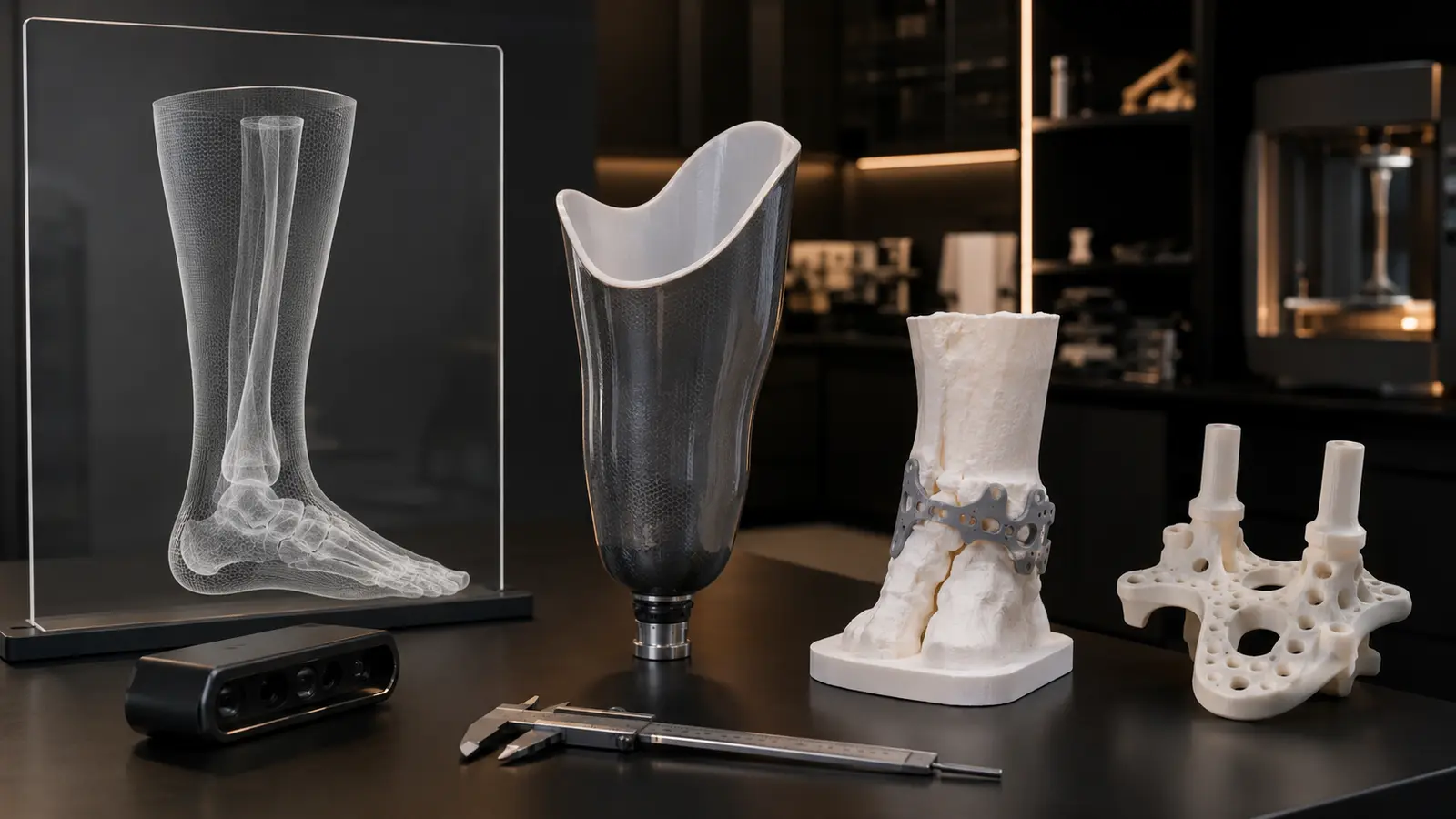
3D printing for patient-specific medical devices and prosthetics
An overview of scanning, design, printing and validation for anatomical models, guides, orthoses and prostheses.
PATIENT-SPECIFIC DESIGN
The key advantage is turning anatomy into patient-specific geometry
CT, MRI, 3D scanning or anatomical measurements can support anatomical models, planning tools, orthoses and prostheses tailored to the user without dedicated tooling at every stage.
Medical 3D printing ranges from non-contact communication models to skin-contacting or implantable devices. Risk, documentation, materials and regulatory requirements differ substantially.
SCAN TO DEVICE
A controlled workflow checks every data handoff
- 01
Acquire data
Use an appropriate scan modality and protect personal data.
- 02
Segment and design
Segment anatomy and design clearance, loads and contact under qualified oversight.
- 03
Select process and material
Consider strength, biocompatibility, sterilisation and service life.
- 04
Manufacture and post-process
Control orientation, cleaning, curing, finishing and lot traceability.
- 05
Inspect and approve
Verify dimensions, fit, surface, documentation and intended use.
APPLICATION LEVELS
Applications and control levels
| Application | Purpose | Control focus |
|---|---|---|
| Anatomical model | Planning and communication | Accuracy, colour and laterality |
| Surgical guide | Guide tool position | Fit, sleeve, sterilisation, validated resin |
| Orthosis | Support or restrict movement | Pressure, skin contact, durability |
| Prosthesis | Replace or assist function | Biomechanics, fit, fatigue, service |
SAFETY & RESPONSIBILITY
Patient-use devices require qualified professional oversight
- Define intended use and contact duration.
- Use materials and processes supported for that indication.
- Protect patient data and file access.
- Retain revision, lot and post-processing history.
- Perform risk assessment and validation as required.
- Do not use this article as medical diagnosis or device approval.
Fast 3D Print can support models, prototypes, scanning and agreed manufacturing specifications; patient-use decisions remain with qualified professionals and responsible organisations.
Turn knowledge into the right production decision
Send us your file, dimensions, quantity and intended use. Our team can compare process, material, finishing and production risk before work begins.
Discuss your project →