Dental models
Diagnosis, occlusion analysis, restorative and orthodontic planning.
 THE FAST 3D PRINTGet a quotation →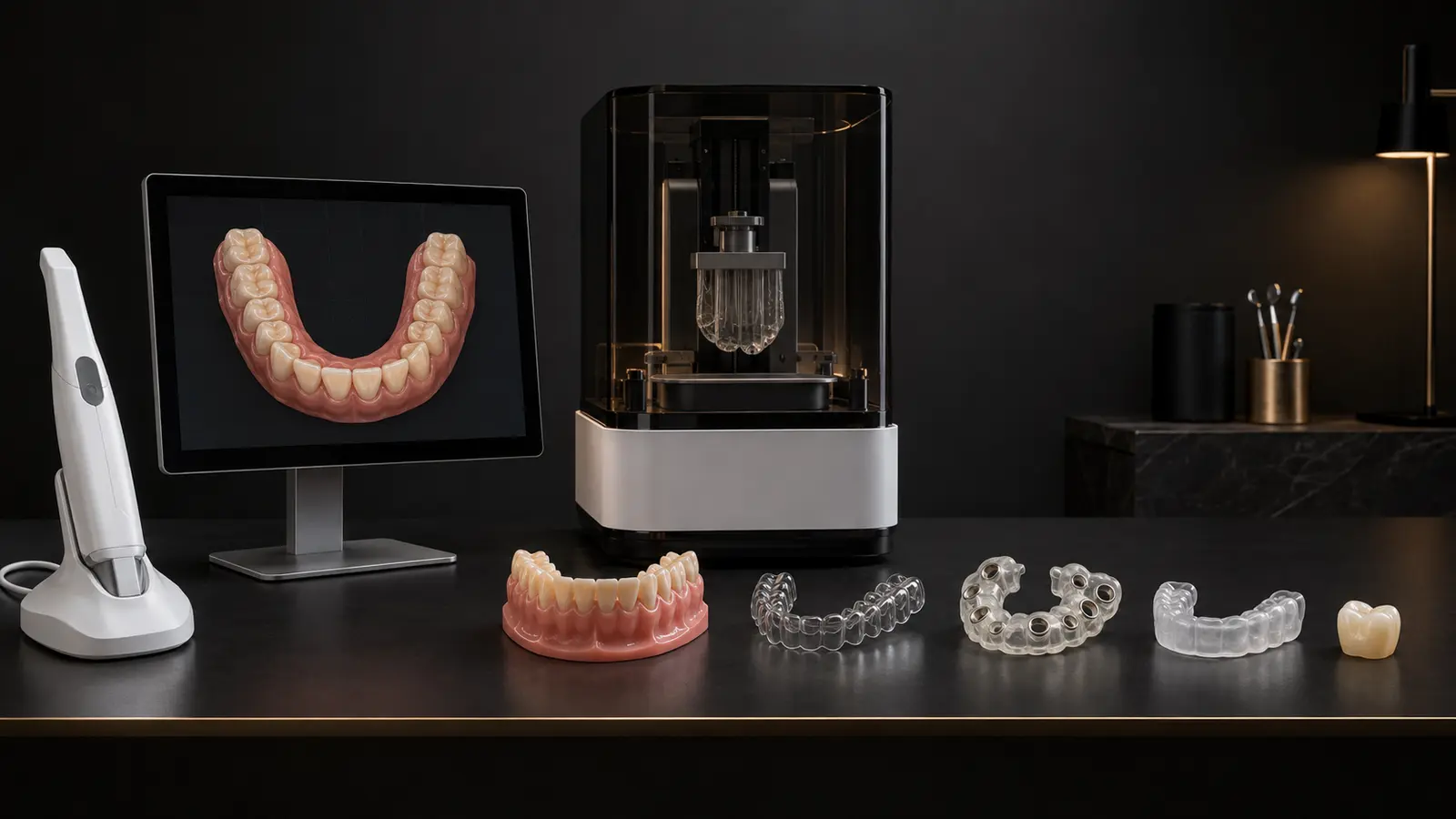
Digital dentistry from intraoral scanning and CAD to models, aligners, surgical guides and patient-specific devices.
DIGITAL DENTISTRY
Digital dentistry connects intraoral or CT/CBCT data with CAD and high-resolution resin printing, reducing manual work while preserving patient-specific geometry.
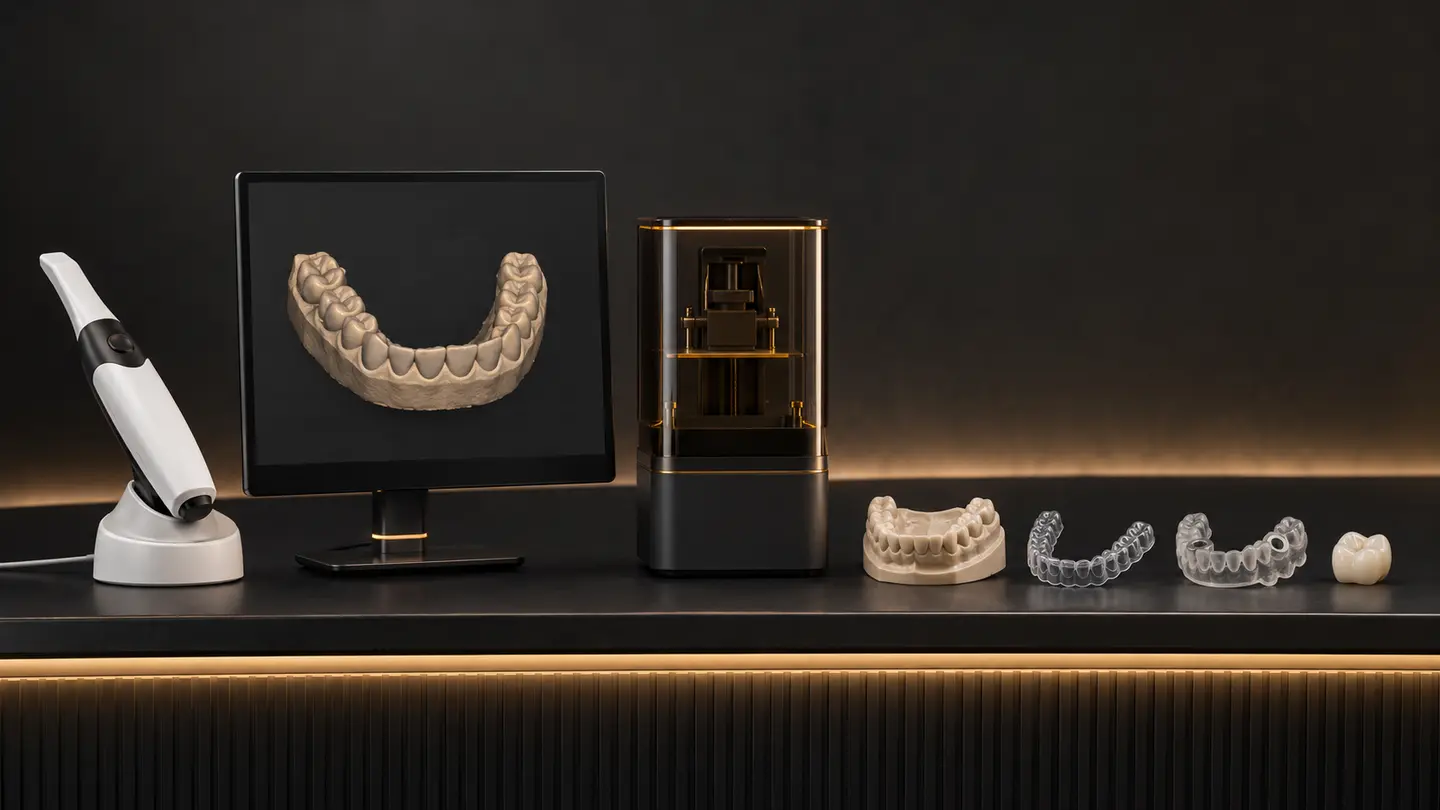
Use intraoral scanning or CT/CBCT where appropriate.
Plan treatment and design the model or device in dental CAD.
Use a validated process, resin, orientation and support strategy.
Post-process for the specified time to achieve validated properties and safety.
Verify dimensions, fit and traceability before clinical use.
FIVE APPLICATIONS
Diagnosis, occlusion analysis, restorative and orthodontic planning.
Print staged models for thermoforming patient-specific aligners.
Combine CT and dental data to control implant position, angle and depth.
Produce temporary restorations, models and patient-specific devices.
Create patient-specific maxillofacial models and prosthetic patterns.
SLA · DLP · LCD
| Process | Principle | Strength | Examples |
|---|---|---|---|
| SLA | Laser traces each layer | Fine detail and smooth surfaces | Model · Guide · Crown/Bridge model |
| DLP | Projector exposes a full layer | Fast and batch-friendly | Aligner model · Guide · Splint |
| LCD / MSLA | LCD masks UV light | Accessible and fast | Model · Diagnostic · Orthodontic |
BIOCOMPATIBLE MATERIALS
Prioritises dimensional accuracy and surface quality for models.
Must be biocompatible, strong and compatible with a validated sterilisation method.
Requires bite resistance, toughness and safe intraoral contact.
Designed for functional denture bases and teeth.
For temporary restorations within the material's validated indication.
Patient-contact devices require validated printers, materials, software and post-processing, used by appropriately qualified professionals.
CLINICAL VALUE
THE ACCURACY CHAIN
Error can accumulate through scanning, CT/CBCT registration, CAD, orientation, supports, printing shrinkage, washing, curing and sterilisation. Accuracy must therefore be evaluated on the final device after the complete process.
A small pixel or layer height does not guarantee fit when calibration, resin profile or post-curing is mismatched. Clinical workflows require a validated combination of printer, material, software and processing.
Resolution, missing areas and registration affect the design from the start.
Offsets, clearances, sleeves and margins must match device requirements.
Orientation, supports and profile change surface, strength and dimensions.
Time, solvent, light and temperature must remain within the validated window.
VALIDATION & SAFETY
Each resin permits different contact locations and durations.
Match printer, material version, layer height and software to the manufacturer's documentation.
Record solvent, wash cycles, temperature, time and curing equipment.
Remove supports and residual resin, then inspect critical areas before use.
Link the patient, file, material, printer, operator and inspection result within the appropriate system.
This is manufacturing-process information, not medical advice. Treatment planning and device use must remain under qualified professionals.
LAB CAPACITY
| Application | Critical control | Acceptance focus |
|---|---|---|
| Dental model | Arch dimensions, margins and model base | Accuracy and surface |
| Clear-aligner model | Consistency across stages and batch speed | Tooth form and thermoforming |
| Surgical guide | Biocompatibility, sleeve fit and sterilisation | Position, angle and stability |
| Splint / Night guard | Toughness, clarity and curing | Fit, edges and occlusion |
| Temporary crown / bridge | Shade, margins and approved service duration | Fit, contacts and surface |
SERVICE BUYER GUIDE
Dental models, aligner models and surgical guides carry different risk. A provider should explain printer, resin, software, washing, post-cure, calibration, lot traceability and accuracy criteria. Patient-contact work requires validated materials and workflows under qualified professional oversight.
Send a file or image with your brief so Fast 3D Print can assess process, material, lead time and price before production.
Send us your file, dimensions, quantity and intended use. Our team can compare process, material, finishing and production risk before work begins.
Discuss your project →