
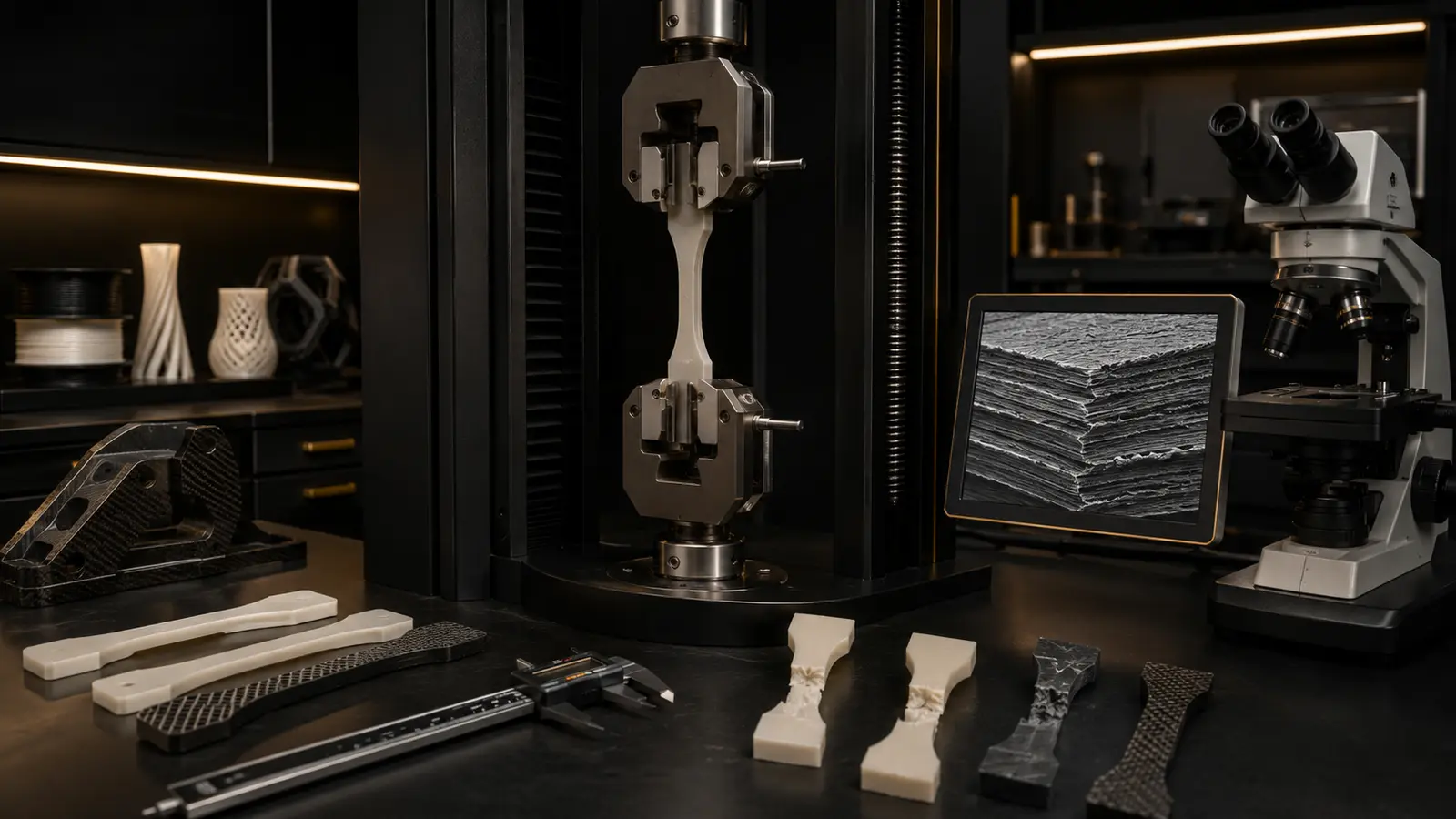
Testing 3D-printed materials before production
From standard coupons to functional tests that verify load, heat and dimensional performance.
VALIDATE BEFORE SCALE
A data-sheet value is not automatically the printed-part value
The same material can behave differently with machine, moisture, temperature, orientation, layer height, voids and post-processing. Loaded or high-risk parts need a validation plan before production approval.
A useful test starts with the feared failure mode: tensile for pulling, flexural/modulus for deflection, creep for sustained load, and UV/temperature for outdoor service. Test what represents the application rather than every possible property.
TEST MATRIX
Match the test to the engineering question
| Test | Question answered | Key variables |
|---|---|---|
| Tensile | Strength and elongation under tension | Orientation, moisture, strain rate |
| Flexural | Deflection and failure in bending | Span, thickness, layers |
| Impact | Resistance to sudden impact | Notch and temperature |
| Heat / HDT | When deformation begins under heat | Load and post-cure |
| Creep / Fatigue | Long-term or cyclic failure | Time, cycles, stress, temperature |
| Dimensional inspection | Repeatability and fit | Datums and measurement method |
COUPON · PART · BATCH
Use three levels of evidence
- 01
Material coupon
Use standard geometry to compare materials and orientations under control.
- 02
Prototype part
Test real geometry, fasteners, walls and stress concentrations absent from coupons.
- 03
Functional test
Assemble and test the real load case or a representative rig.
- 04
Batch inspection
Set sampling, lot traceability and acceptance criteria for repeat production.
TESTING BRIEF
What a prototype and test supplier needs
- Material, grade, colour and lot.
- Machine, settings, orientation and post-processing.
- Required standard or coupon geometry.
- Pre-test conditioning such as dry or humidity-controlled state.
- Sample count and pass/fail criteria.
- Report, plots and failure-surface photographs.
Safety-critical, medical, aerospace or regulated work requires an appropriately qualified engineer and laboratory to define validation.
Turn knowledge into the right production decision
Send us your file, dimensions, quantity and intended use. Our team can compare process, material, finishing and production risk before work begins.
Discuss your project →